
The Bank of Canada rate hike on October 28, 2026 lifted the target for the overnight rate by 25 basis points to 2.50%, the first increase since the summer of 2023 and the first move after seven consecutive holds at 2.25%. For Canadian borrowers, savers and anyone watching the loonie, it marks a clear turn in the cycle.
This article summarises what the Bank announced, how markets had positioned for it, and what the shift could mean in practical terms. The event was reported by multiple outlets, including the CBC, The Globe and Mail and FXStreet.
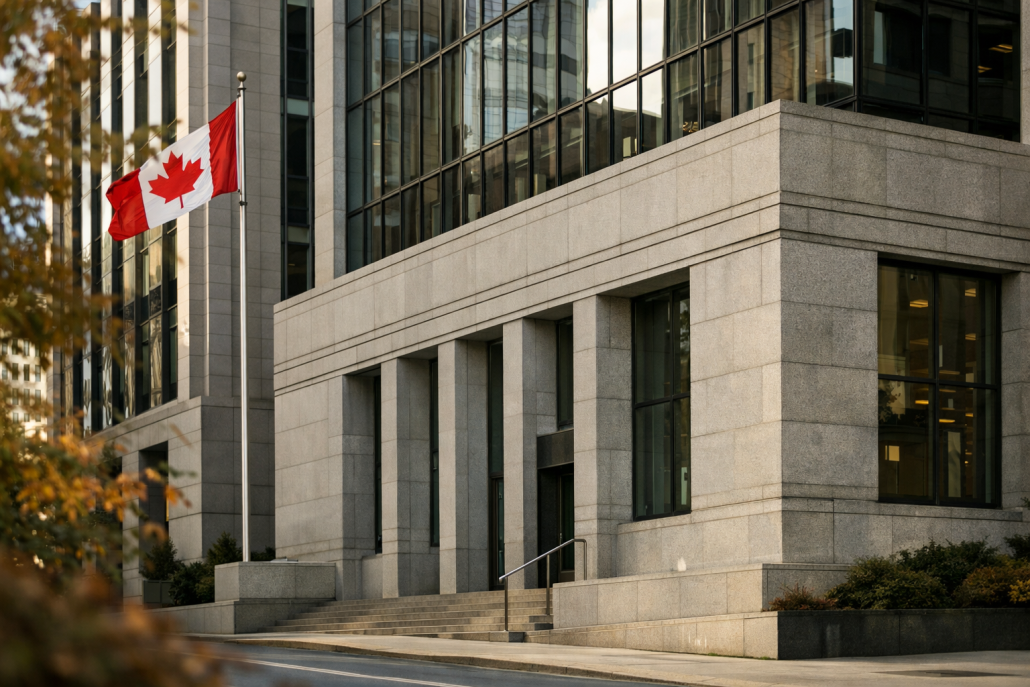
The decision — what the Bank announced — Bank of Canada rate hike
The headline is simple: a 25 basis point increase, the first rise in three years. The move came alongside the quarterly Monetary Policy Report, in which the Bank revised its inflation forecasts higher. Understanding the Bank of Canada rate hike in full requires looking at these details closely.
The core facts of the announcement, as reported, are summarised in the table below. These figures put the Bank of Canada rate hike into clearer perspective.
| Item | Detail |
|---|---|
| Decision date | October 28, 2026 |
| New target for the overnight rate | 2.50% |
| Size of the move | +25 basis points |
| Previous rate | 2.25% (held for seven consecutive meetings) |
| Last previous increase | Summer of 2023 |
| September CPI (year-over-year) | 3.1% |
| Gasoline prices (year-over-year) | +27.8% |
| Market-implied probability shift | From ~30% to ~80% after Governor Macklem’s Saturday remarks |
| Reuters poll (Oct 21–23, 34 economists) | 19 of 34 expected the hike; majority saw one further 25bp rise before end-March 2027 |
What it means
The most striking element is the driver. September CPI at 3.1% year-over-year was pushed up largely by gasoline prices, which were 27.8% higher than a year earlier. That is a very different inflation story from the broad demand-driven surge of the early 2020s, and it is one reason the decision was closely watched: energy pass-through can be sharper and shorter-lived than services inflation, which complicates how aggressively a central bank should respond. This context matters for anyone following the Bank of Canada rate hike.
Market positioning around the decision moved quickly. After Governor Tiff Macklem’s remarks the previous Saturday, implied probability of a hike jumped from roughly 30% to about 80%. By Wednesday morning the surprise element was largely priced out, and attention shifted to what the Bank would signal for the months ahead. It is a central thread in the wider Bank of Canada rate hike.
For Canadian households, a higher overnight rate typically feeds through to prime-linked lending — variable-rate mortgages, home equity lines of credit and many business loans. The Reuters poll of 34 economists, conducted October 21–23, found a majority expecting one further 25bp increase before the end of March 2027, which would compound that effect if realised. For cross-border travellers and importers, any widening of the policy-rate differential with other G7 central banks is one of several inputs that can influence the Canadian dollar, though exchange rates respond to many factors at once. Such details shaped how the Bank of Canada rate hike unfolded.
It is worth being careful with the interpretation. This was widely seen as a response to a specific inflation reading dominated by energy prices rather than a signal of a long tightening campaign. Whether a second hike actually arrives will depend on how the data evolve. This is one of the defining aspects of the Bank of Canada rate hike.
Explore the full data behind this article: bank branches worldwide and ATMs worldwide in the gf6.com directory.
Methodology
The facts above are drawn from the Bank of Canada’s October 28, 2026 rate decision and accompanying Monetary Policy Report as covered by the CBC, with corroboration from The Globe and Mail and FXStreet. The Reuters poll figures and market-implied probability shift are reproduced as reported. For readers researching where to transact in-country, gf6.com maintains a worldwide directory that includes banks in Canada; coverage varies by country and the directory is a large but incomplete sample compiled from public sources and manual research. No figure in this article has been recalculated or estimated.
Frequently Asked Questions
What did the Bank of Canada actually do on October 28, 2026?
It raised the target for the overnight rate by 25 basis points to 2.50%. This was the first increase since the summer of 2023 and followed seven consecutive holds at 2.25%.
Why did the Bank raise rates now?
September CPI had risen to 3.1% year-over-year, driven largely by gasoline prices up 27.8%. The Bank also revised its inflation forecasts higher in the quarterly Monetary Policy Report released the same day.
Was the hike a surprise?
Not by Wednesday. After Governor Tiff Macklem’s remarks the previous Saturday, market-implied probability of a hike moved from roughly 30% to about 80%. A Reuters poll of 34 economists conducted October 21–23 found 19 of 34 expecting the move.
Will there be another hike?
According to the Reuters poll cited above, a majority of the 34 economists surveyed expected one further 25bp increase before the end of March 2027. Whether that happens will depend on incoming data; it is not a commitment from the Bank.
How does this affect Canadian mortgage holders?
A higher overnight rate typically feeds through to prime-linked products such as variable-rate mortgages and lines of credit. The precise impact on any individual loan depends on the lender’s pricing and the loan’s terms.
Where can I read the original reporting?
The decision was covered live by the CBC, with additional coverage from The Globe and Mail and FXStreet.
This article was produced with AI assistance from publicly available sources and is handled under our editorial standards and AI policy.

I have been online since 1995. For many years, I worked in the e-commerce sector, setting up several online shops, and have always been interested in data analysis. In 2007, I moved to the Seychelles to work from there or as a digital nomad. In recent years, I have increasingly specialised in the financial sector. I manage the Seychelles’ Commercial Register and am also very familiar with the offshore world. GF6.com is a project I have been working on for many years. I built and curated the 445,000-entry bank database myself over a period of six years, and for the past two years or so I have also been using AI to achieve better structures.
More from this author →