
The surprise on 30 July 2026 was not that the Bank of England held Bank Rate at 3.75% — it was that three members of the Monetary Policy Committee voted to raise it. Catherine Mann joined Megan Greene and Chief Economist Huw Pill in calling for a 25bp rise to 4.00%, the first time three MPC members have dissented for a hike in this cycle. Understanding the Bank of England rate decision in full requires looking at these details closely.
This article unpacks the Bank of England rate decision using only what the Bank itself and the reporting outlets published on the day. It draws on gf6.com’s ongoing coverage of banking events across the world, alongside our four-year curated directory of bank branches and ATMs, to place the vote in a practical context for readers watching sterling, gilts and UK mortgage pricing.
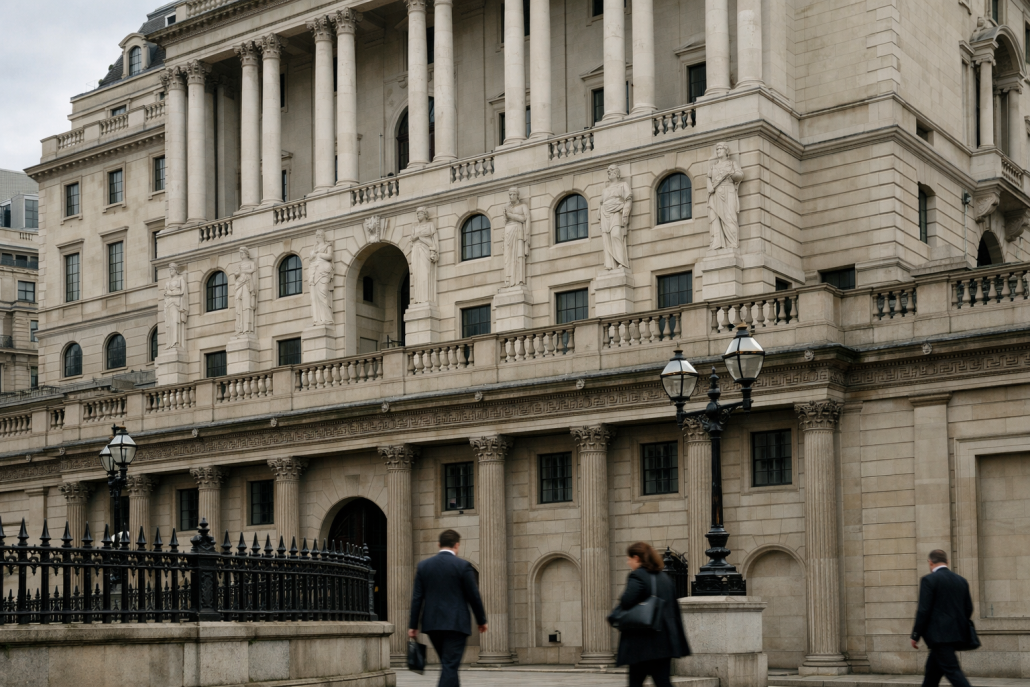
The finding — what the vote actually showed — Bank of England rate decision
The headline number is the split. On 30 July 2026 the Bank of England’s Monetary Policy Committee voted 6-3 to hold Bank Rate at 3.75%, a more hawkish outcome than the 7-2 split most Reuters-polled economists had forecast. The decision continues a pause that began in early 2026, when the Middle East conflict drove energy prices sharply higher. These figures put the Bank of England rate decision into clearer perspective.
The core facts of the day, as published by the Bank and reported by RTÉ, are as follows:
- Date: 30 July 2026
- Vote: 6-3 to hold Bank Rate at 3.75%
- Dissenters (for a 25bp rise to 4.00%): Catherine Mann, Megan Greene, Huw Pill (Chief Economist)
- Reuters consensus expectation: 7-2 hold
- CPI inflation projection (new MPR): peaking at 3.2% in Q4 2026
- June CPI reading (referenced in the MPR): 2.6%
- Accompanying event: Governor Andrew Bailey’s press conference, acknowledging the sharply divided committee
The event was covered by multiple outlets in real time, including a live blog from Mortgage Professional Australia’s UK edition and the Bank’s own Monetary Policy Summary and Minutes.
What it means
The direction of travel is what matters here. A 6-3 vote is still a hold, but it is a hold with visibly less consensus than markets had priced. Three dissenters for a hike in the same cycle is a level of hawkish pressure that had not previously been reached, and it arrives at the same meeting as an upgraded inflation projection: the Bank now expects CPI to peak at 3.2% in Q4 2026, materially above the June reading of 2.6%. This context matters for anyone following the Bank of England rate decision.
The combination — a bigger hawkish minority, plus a higher near-term inflation peak in the Bank’s own forecast — is widely seen as a signal that the next move, if there is one, is more likely to be up than down. That said, the majority still voted to hold, and Governor Bailey used his press conference to acknowledge the divisions rather than pre-commit to any path. It is a central thread in the wider Bank of England rate decision.
For sterling and gilt markets, the immediate story is repricing: a more hawkish split typically pulls forward expectations of a hike and can lift short-dated yields. For UK households, the read-across to mortgage pricing runs through swap rates rather than Bank Rate directly, so the effect on fixed-rate deals depends on how lenders interpret the same signal. None of this is asserted here as a forecast — it is simply the mechanism through which an MPC vote reaches the high street. Such details shaped how the Bank of England rate decision unfolded.
The pause itself has an origin worth remembering. It began in early 2026 when the Middle East conflict pushed energy prices sharply higher, complicating the disinflation story that had dominated 2025. The July 2026 decision is, in effect, the Bank taking stock of that shock and its second-round effects on wages and services prices. This is one of the defining aspects of the Bank of England rate decision.
How this fits into the UK banking picture
Rate decisions land on a physical banking network as well as a financial one. The UK retail banking footprint — high-street branches, in-branch ATMs and free-to-use cash machines — is the channel through which most households will actually feel changes in savings rates, overdraft pricing and mortgage conversations. You can browse our directory of banks in United Kingdom to see how that network is distributed across the country in gf6.com’s records.
Rate policy and branch access are not the same story, but they intersect. Savers responding to a shifting rate outlook still, in many cases, walk into a branch to switch products or open a fixed-term account. That is one reason MPC meetings remain closely watched beyond the trading desks.
Explore the full data behind this article: bank branches worldwide and ATMs worldwide in the gf6.com directory.
Methodology
The event details in this piece — the 30 July 2026 date, the 6-3 vote, the 3.75% Bank Rate, the named dissenters, the 7-2 Reuters consensus, the 3.2% Q4 2026 CPI peak and the 2.6% June reading — are taken directly from the Bank of England’s Monetary Policy Summary and Minutes and from reporting by RTÉ and Mortgage Professional Australia’s UK live blog, all linked above. No figures have been added, rounded or recalculated.
Contextual references to the UK banking network draw on gf6.com’s own curated directory of bank branches and ATMs, built manually from public sources since 2020 and expanded over four years. The directory is a large but incomplete sample of the world’s financial infrastructure; coverage varies by country and it is not an official record.
Frequently asked questions
What did the Bank of England decide on 30 July 2026?
The Monetary Policy Committee voted 6-3 to hold Bank Rate at 3.75%. Three members — Catherine Mann, Megan Greene and Chief Economist Huw Pill — voted for a 25bp rise to 4.00%.
Why was the vote described as a surprise?
Most economists polled by Reuters had expected a 7-2 split in favour of holding. The actual 6-3 outcome showed a larger hawkish minority than the market consensus had priced in.
What is the Bank now forecasting for inflation?
The Monetary Policy Report published on 30 July 2026 projects CPI inflation peaking at 3.2% in Q4 2026, up from a June reading of 2.6%.
Why has Bank Rate been on hold?
The pause began in early 2026 after the Middle East conflict drove energy prices sharply higher. The MPC has since been assessing how that shock feeds through to underlying inflation.
Does this mean a rate hike is coming next?
The decision itself was a hold, so no hike has been announced. Three dissenters voting for a rise is widely seen as a hawkish signal, but the majority still supported keeping Bank Rate at 3.75%.
Where can I read the primary sources?
The Bank of England’s own Monetary Policy Summary and Minutes and the reporting from RTÉ and Mortgage Professional Australia’s UK edition are all linked in the article above.
This article was produced with AI assistance from publicly available sources and is handled under our editorial standards and AI policy.

I have been online since 1995. For many years, I worked in the e-commerce sector, setting up several online shops, and have always been interested in data analysis. In 2007, I moved to the Seychelles to work from there or as a digital nomad. In recent years, I have increasingly specialised in the financial sector. I manage the Seychelles’ Commercial Register and am also very familiar with the offshore world. GF6.com is a project I have been working on for many years. I built and curated the 445,000-entry bank database myself over a period of six years, and for the past two years or so I have also been using AI to achieve better structures.
More from this author →
