
For the first time since it adopted a 2% price goal in 2013, the Bank of Japan has told the world the target has essentially been reached. On 30 October 2026 the board voted 8-1 to leave the overnight policy rate at 1.25% — the highest level since 1995 — and stated that underlying inflation is now broadly consistent with 2%. Understanding the Bank of Japan 1.25% rate hold in full requires looking at these details closely.
This Bank of Japan 1.25% rate hold is a stylistic rewrite of a public monetary-policy decision, drawing on the directory context of gf6.com, a worldwide bank and ATM database. Below you will find the locked facts of the decision, what it plausibly means for Japanese financial infrastructure, and a transparent methodology note.
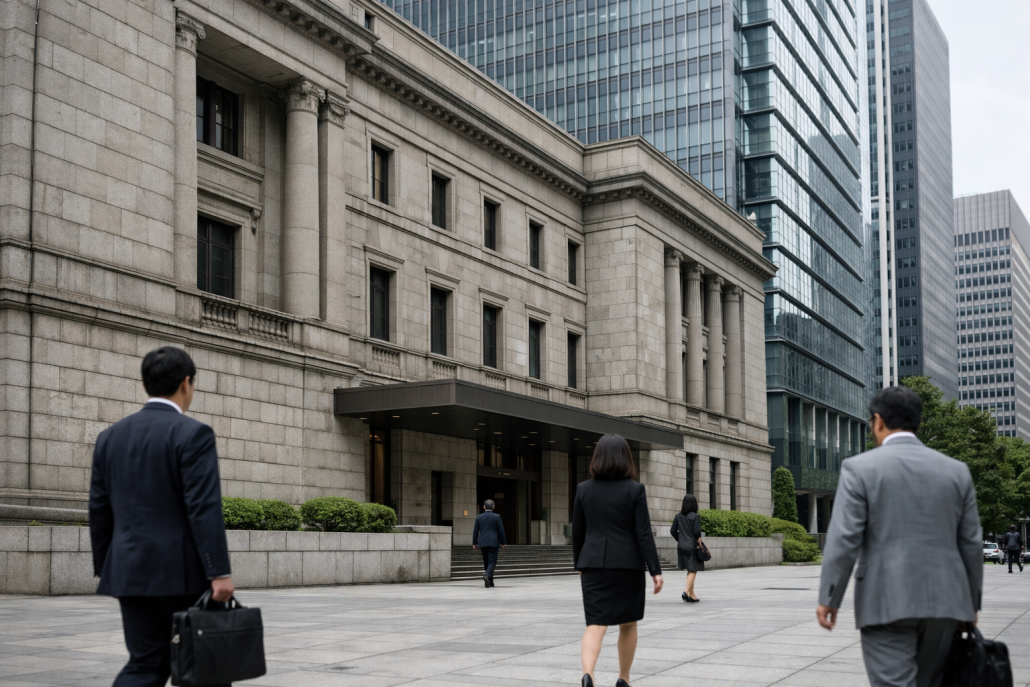
The finding — what the BoJ actually decided — Bank of Japan 1.25% rate hold
The headline from Tokyo was not the hold itself, but the language that came with it. Here are the locked facts as reported: These figures put the Bank of Japan 1.25% rate hold into clearer perspective.
- On October 30, 2026, the Bank of Japan voted 8-1 to hold its overnight policy rate at 1.25% — the highest level since 1995 — following September’s 25 bp hike from 1.00%.
- For the first time since its 2% target was adopted in 2013, the BoJ stated that underlying inflation is broadly consistent with that goal.
- Board member Hajime Takata cast the sole dissent, proposing a rise to 1.50%, arguing monetary policy had entered a new phase and rates should move toward neutral more quickly.
- The BoJ simultaneously voted unanimously to accelerate ETF offloading to an annual pace of approximately ¥860 billion (book value) beginning January 2027.
- The bank lifted its fiscal 2027 core inflation forecast to 2.6% from 2.4%.
- A CNBC survey of 16 economists found all expected the BoJ to set the stage for a rate rise in December or January.
The decision was first reported by Seoul Economic Daily and independently covered by multiple outlets, including Seoul Economic Daily, GuruFocus and Dukascopy.
What it means
Two things stand out. First, the policy rate is now at a level you would have to go back to 1995 to match — a generational break with the deflation-era settings that dominated Japanese finance for a quarter of a century. Second, by stating that underlying inflation is broadly consistent with 2%, the BoJ has effectively declared mission accomplished on the goal it set in 2013. That is a symbolic turning point, not just a technical one. This context matters for anyone following the Bank of Japan 1.25% rate hold.
The 8-1 split is also informative. Hajime Takata’s dissent in favour of 1.50% is a signal — one voice on the board — that some members see policy as still behind a neutral setting. It is likely, though not certain, that this is why the CNBC survey of 16 economists uniformly expected the bank to prepare the ground for a further hike in December or January. It is a central thread in the wider Bank of Japan 1.25% rate hold.
The unanimous vote to accelerate ETF offloading to an annual pace of approximately ¥860 billion (book value) from January 2027 is the quieter story. It confirms balance-sheet normalisation is now running in parallel with rate normalisation, rather than being deferred. The upward revision of the fiscal 2027 core inflation forecast to 2.6% from 2.4% supports the bank’s framing. Such details shaped how the Bank of Japan 1.25% rate hold unfolded.
For the branch and ATM network across banks in Japan, higher short rates eventually feed through into deposit pricing and lending margins. We do not have figures on that in this release, so we will not speculate on magnitudes.
Explore the full data behind this article: bank branches worldwide and ATMs worldwide in the gf6.com directory.
Methodology
The event facts in this article — the 8-1 vote, the 1.25% rate, the September 25 bp hike from 1.00%, the Takata dissent at 1.50%, the ¥860 billion ETF offloading pace, the 2.6% fiscal 2027 core inflation forecast, and the CNBC survey of 16 economists — are reproduced from public reporting of the Bank of Japan’s 30 October 2026 decision. We did not independently verify the BoJ statement; we rely on the outlets cited above, which corroborate one another. gf6.com itself is a worldwide directory of roughly 445,000 bank branches and ATMs, curated manually since 2020 from public sources. The directory is a large but incomplete sample of global financial infrastructure; coverage varies by country. No branch-level figures from the directory are used in this piece. This is one of the defining aspects of the Bank of Japan 1.25% rate hold.
No numbers, names or forecasts beyond those listed above are asserted here. Where context is offered — for example, that the hold was widely read as a prelude to a further hike — it reflects the reported market view rather than our own forecast.
Frequently asked questions
What did the Bank of Japan decide on 30 October 2026?
The board voted 8-1 to hold the overnight policy rate at 1.25%, following a 25 bp hike from 1.00% in September. It also voted unanimously to accelerate ETF offloading to roughly ¥860 billion a year in book-value terms from January 2027.
Why is the 1.25% level significant?
It is the highest BoJ policy rate since 1995. For many observers, the move from near-zero rates to this level marks the end of the deflation-era policy framework that defined Japanese finance for most of the past three decades.
Has the 2% inflation target really been met?
The BoJ stated for the first time since the target was adopted in 2013 that underlying inflation is broadly consistent with 2%. That is the bank’s own characterisation; it is a judgement call, not a mechanical rule.
Who dissented, and why?
Board member Hajime Takata cast the sole dissent, proposing a rise to 1.50%. He argued that monetary policy had entered a new phase and that rates should move toward neutral more quickly.
Is another rate hike coming?
A CNBC survey of 16 economists found all of them expected the BoJ to set the stage for a rate rise in December or January. The bank also lifted its fiscal 2027 core inflation forecast to 2.6% from 2.4%, which markets generally read as consistent with that path.
Where can I read the original reporting?
The decision was reported by Seoul Economic Daily and corroborated by GuruFocus and Dukascopy; all three are linked above. For the full policy statement you should consult the Bank of Japan directly.
This article was produced with AI assistance from publicly available sources and is handled under our editorial standards and AI policy.

I have been online since 1995. For many years, I worked in the e-commerce sector, setting up several online shops, and have always been interested in data analysis. In 2007, I moved to the Seychelles to work from there or as a digital nomad. In recent years, I have increasingly specialised in the financial sector. I manage the Seychelles’ Commercial Register and am also very familiar with the offshore world. GF6.com is a project I have been working on for many years. I built and curated the 445,000-entry bank database myself over a period of six years, and for the past two years or so I have also been using AI to achieve better structures.
More from this author →
