
The BOJ October 2026 meeting is set to end on 30 October with no change to the policy rate, which already stands at 1.25% after September’s hike, according to Reuters reporting on 20 October 2026 that cited four sources familiar with the Bank of Japan’s thinking. The same sources say the board will slightly lift its core consumer-inflation forecast for fiscal 2027, from the July projection of 2.4%, to reflect a renewed spike in crude-oil prices feeding through to consumer prices.
This article summarises what those sources told Reuters about the two-day meeting, how it fits into the BOJ’s broader rate-hike cycle, and what it could mean for Japanese government bond yields, the yen and the margins of Japanese banks. The event was reported by multiple outlets, including Investing.com and FXStreet, with the original story carried by U.S. News & World Report.
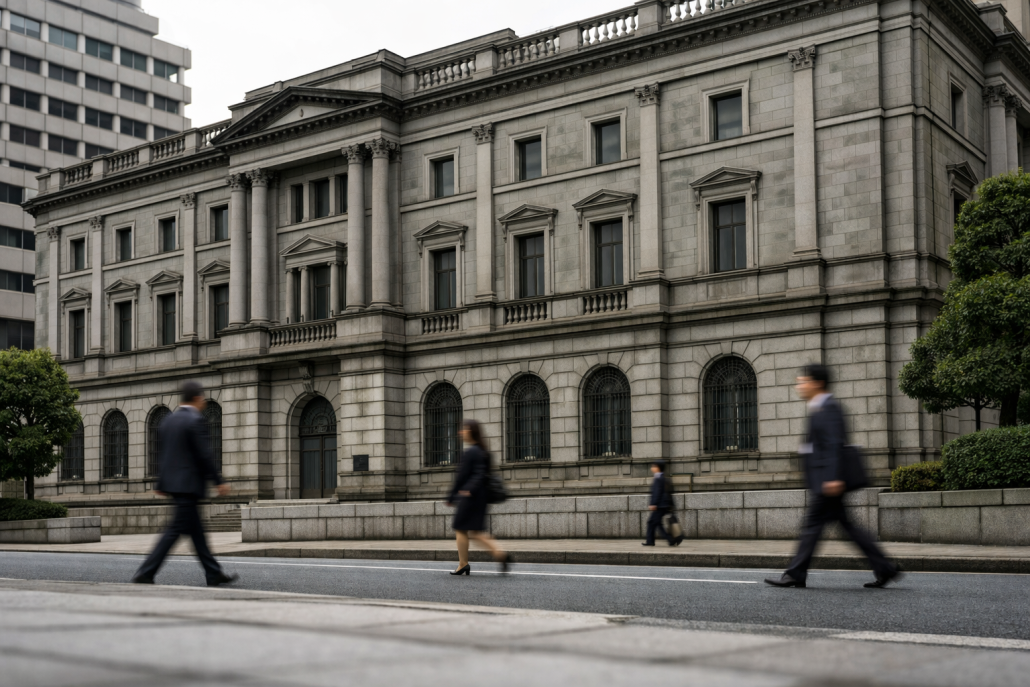
The finding — what the sources told Reuters — BOJ October 2026 meeting
According to the 20 October 2026 Reuters report, the Bank of Japan is on course to hold its policy rate steady when its two-day Monetary Policy Meeting concludes on 30 October 2026. The central bank had already hiked to 1.25% in September. The headline shift at this meeting is not the rate itself but a slight upward revision to the FY2027 core inflation forecast and a signal that financial conditions remain accommodative enough to allow a further rate hike as early as December 2026. Understanding the BOJ October 2026 meeting in full requires looking at these details closely.
The specific numbers reported by Reuters’ four sources are as follows:
- Policy rate: held steady at 1.25% (hiked in September 2026)
- Meeting date: two-day MPM ending 30 October 2026
- FY2027 core CPI forecast: revised slightly up from the July projection of 2.4%
- FY2026 real GDP growth forecast: likely maintained at 0.6%
- FY2027 real GDP growth forecast: likely maintained at 0.8%
- Driver of inflation revision: renewed spike in crude-oil prices passing through to consumer prices
- Second-round effects: no evidence of dangerous wage-price spiral, revisions described as minor
- Growth composition: robust AI-goods exports offsetting soft consumption
- Next possible hike: as early as December 2026
What it means
The combination of a hold now and a small upward nudge to the FY2027 inflation forecast is widely seen as a classic hawkish-hold stance. The BOJ is telling markets that inflation is tracking at or slightly above its 2% target on a multi-year view, while buying itself a few more weeks to confirm the picture before moving again. These figures put the BOJ October 2026 meeting into clearer perspective.
The explicit framing of financial conditions as still accommodative, combined with the September hike to 1.25%, points to December 2026 as the next live meeting for a rate decision. That is an interpretation of the signal, not a commitment: the sources describe the inflation revision as minor and tie it specifically to oil, not to a broader wage-price spiral. This context matters for anyone following the BOJ October 2026 meeting.
For Japanese government bond yields, a credible path toward a further hike typically supports higher yields at the short end of the curve. For the yen, a BOJ that is still tightening while other major central banks debate cuts is generally seen as supportive, though currency moves depend on many other factors. For Japanese banks, a policy rate at 1.25% with scope to rise further is the kind of environment that tends to widen net interest margins compared with the long era of zero and negative rates. It is a central thread in the wider BOJ October 2026 meeting.
The growth story reported by the sources is also notable. Keeping FY2026 growth at 0.6% and FY2027 at 0.8% while flagging robust AI-goods exports as the offset to soft consumption suggests the BOJ sees external demand, rather than the domestic consumer, as the main engine of the current expansion. Such details shaped how the BOJ October 2026 meeting unfolded.
Explore the full data behind this article: bank branches worldwide and ATMs worldwide in the gf6.com directory.
Methodology
This is a rewrite in our own words of reporting by Reuters, published on 20 October 2026 and carried by U.S. News & World Report, with corroboration from Investing.com and FXStreet. Every figure in this piece — the 1.25% policy rate, the 2.4% July FY2027 core CPI projection, and the 0.6% / 0.8% growth forecasts for FY2026 and FY2027 — comes directly from that reporting.
gf6.com is a worldwide directory of bank branches and ATMs, curated manually over four years from public sources. We cover roughly 445,000 financial locations globally, including banks in Japan. We publish this news summary as context for readers tracking Japanese monetary policy; we are not the original reporter of the event and we do not independently verify the sources cited by Reuters.
Frequently asked questions
What is the BOJ expected to do at the 30 October 2026 meeting?
According to Reuters sources, the Bank of Japan is expected to hold its policy rate steady at 1.25%, where it was set after the September 2026 hike, and slightly raise its FY2027 core consumer-inflation forecast from the July projection of 2.4%.
Why is the BOJ revising its inflation forecast upward?
The sources cited by Reuters attribute the revision to a renewed spike in crude-oil prices feeding through to consumer prices. They describe the revisions as minor and say there is no evidence of a dangerous second-round wage-price spiral.
When is the next possible rate hike?
The reporting indicates the BOJ will signal that financial conditions remain accommodative, preserving scope for a further rate hike as early as December 2026. This is a signal of possibility, not a confirmed decision.
Are the BOJ's growth forecasts changing?
The sources say the BOJ is likely to maintain its real GDP growth forecasts at 0.6% for FY2026 and 0.8% for FY2027, with robust AI-goods exports offsetting soft domestic consumption.
What does this mean for the yen and Japanese bank margins?
A policy rate at 1.25% with scope for further hikes is generally seen as supportive for the yen and as widening net interest margins for Japanese banks compared with the long era of ultra-low rates. Actual market outcomes depend on many additional factors.
Is this the BOJ's official announcement?
No. This is pre-meeting reporting from Reuters based on four unnamed sources familiar with the BOJ’s thinking. The Bank of Japan’s official statement and updated outlook report are scheduled for release at the end of the 30 October 2026 meeting.
This article was produced with AI assistance from publicly available sources and is handled under our editorial standards and AI policy.

I have been online since 1995. For many years, I worked in the e-commerce sector, setting up several online shops, and have always been interested in data analysis. In 2007, I moved to the Seychelles to work from there or as a digital nomad. In recent years, I have increasingly specialised in the financial sector. I manage the Seychelles’ Commercial Register and am also very familiar with the offshore world. GF6.com is a project I have been working on for many years. I built and curated the 445,000-entry bank database myself over a period of six years, and for the past two years or so I have also been using AI to achieve better structures.
More from this author →
