
Bank customers across India are heading into an unusual five-day stretch of disrupted branch service, after the country’s largest banking union alliance called a three-day nationwide strike for 28–30 September 2026 and regulators responded with emergency measures rarely seen in the sector. The India bank strike September 2026 follows the collapse of last-minute conciliation talks in New Delhi.
This article rewrites public reporting on the dispute using gf6.com’s international directory context on India’s banking network. gf6.com is a worldwide bank and ATM directory curated over four years, and this piece places the strike in the frame of what it means for physical access to banks in India.
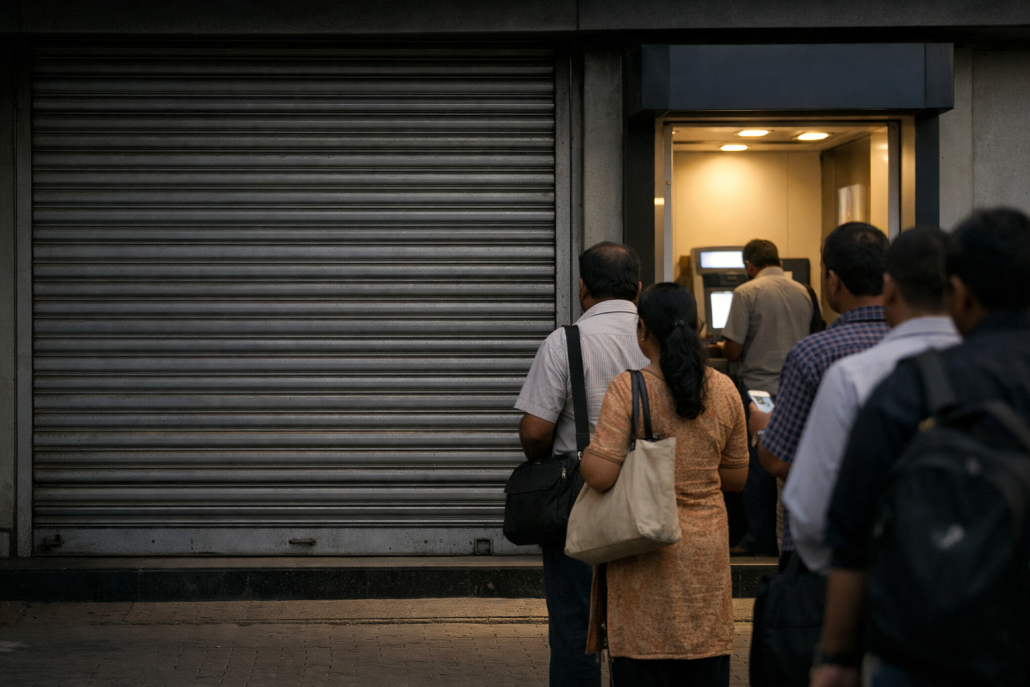
The finding — what has been announced — India bank strike September 2026
The core fact is a coordinated multi-day shutdown across public-sector banks, backed by an alliance that speaks for the vast majority of unionised staff, together with an exceptional Sunday opening ordered by the Finance Ministry to soften the blow. Understanding the India bank strike September 2026 in full requires looking at these details closely.
The confirmed facts of the dispute are as follows:
- The United Forum of Bank Unions (UFBU), an umbrella body of seven bank employee and officer unions representing nearly 90% of public-sector bank staff, confirmed a three-day nationwide strike for September 28–30, 2026.
- The strike call followed a conciliation meeting convened by the Deputy Chief Labour Commissioner in New Delhi on September 22, which produced no breakthrough.
- The unions’ core demand is implementation of a five-day banking week agreed in the March 2024 wage settlement but still not enacted.
- On September 26, 2026 (a Saturday), State Bank of India emailed customers warning of branch closures and urging use of ATMs, YONO, UPI and mobile banking.
- The Finance Ministry directed all public-sector banks and regional rural banks to open on Sunday September 27 — an exceptional move approved by the Reserve Bank of India — to cushion the five-day de facto gap (Sat 26 + Sun 27 + Mon–Wed strike).
- Central government and Railway Board employees received their September salaries early on September 25.
- UFBU has warned of an indefinite strike from October 26 if the five-day banking demand remains unresolved.
The event was reported by Upstox and independently corroborated by PSU Connect and Business Standard.
What it means
The most striking element is not the strike itself, but the countermeasures. The Finance Ministry’s instruction to open all public-sector banks and regional rural banks on Sunday 27 September — with Reserve Bank of India approval — is an unusual reversal of the normal weekly rhythm, and points to how seriously authorities are treating the gap in service. These figures put the India bank strike September 2026 into clearer perspective.
Timing amplifies the impact. With Saturday 26 already a non-working day for many branches and the strike running Monday to Wednesday, customers would otherwise have faced five consecutive days with limited counter service. The early release of September salaries to central government and Railway Board employees on 25 September looks designed to get cash into accounts before that window opens. This context matters for anyone following the India bank strike September 2026.
SBI’s own advisory to customers — pointing to ATMs, YONO, UPI and mobile banking — reflects how much of routine Indian banking now sits outside the branch. That said, cash-heavy tasks, cheque clearing, locker access and in-person service requests are the categories most likely to be delayed. It is a central thread in the wider India bank strike September 2026.
The longer-term signal is the UFBU warning of an indefinite strike from 26 October if the five-day banking week is not enacted. That commitment was agreed in the March 2024 wage settlement, and its non-implementation is what the unions say has forced escalation. Such details shaped how the India bank strike September 2026 unfolded.
How it fits India’s branch network
India has one of the largest and most geographically dispersed banking networks in the world, with dense public-sector coverage in cities and a heavy reliance on regional rural banks and cooperative institutions in smaller towns and villages. A strike that touches public-sector banks and regional rural banks therefore reaches deep into everyday life, not just into metropolitan financial centres. This is one of the defining aspects of the India bank strike September 2026.
For travellers and residents planning cash withdrawals or in-branch business around the strike window, ATMs operated by the affected banks are expected to remain the main fallback, along with UPI-based payments where accepted. gf6.com’s directory lists bank branches and ATMs across the country, which can help you identify alternative nearby locations if your usual branch is shut.
Methodology
This article is a rewrite of already-public reporting. The event details — dates, the identity of UFBU, the conciliation meeting, the Finance Ministry directive, the SBI customer advisory, the early salary release and the October escalation warning — are taken verbatim from the sources listed above and are not independently verified by gf6.com.
Contextual framing around India’s branch and ATM network is drawn from gf6.com’s own curated worldwide directory of roughly 445,000 financial locations (about 346,000 bank branches and 99,000 ATMs), built manually from public sources since 2020. Coverage is large but incomplete and varies by country; the directory is not an official government source. See more on the country page for banks in India.
Frequently asked questions
When exactly is the India bank strike in September 2026?
The United Forum of Bank Unions has called a nationwide strike for 28, 29 and 30 September 2026 — a Monday, Tuesday and Wednesday.
Why are Indian bank unions striking?
According to the reporting cited, the core demand is implementation of a five-day banking week that unions say was agreed in the March 2024 wage settlement but has not yet been enacted. A conciliation meeting on 22 September 2026 in New Delhi did not resolve the dispute.
Will banks really be open on Sunday 27 September 2026?
The Finance Ministry directed all public-sector banks and regional rural banks to open on Sunday 27 September 2026, an exceptional step approved by the Reserve Bank of India to cushion the five-day de facto service gap. Individual branch arrangements may vary.
Will ATMs and UPI keep working during the strike?
State Bank of India’s advisory to customers points them to ATMs, YONO, UPI and mobile banking during the disruption. Digital rails are not directly part of the strike, though cash refills and in-branch services can be affected.
Could the strike be extended beyond three days?
UFBU has warned it will call an indefinite strike from 26 October 2026 if the five-day banking week demand remains unresolved. No further specifics beyond that warning are confirmed in the cited reporting.
Are private-sector banks affected too?
The reporting focuses on public-sector banks and regional rural banks, and it is UFBU — which represents nearly 90% of public-sector bank staff — that has called the strike. Impact on private-sector banks is not specified in the sources used here.
This article was produced with AI assistance from publicly available sources and is handled under our editorial standards and AI policy.

I have been online since 1995. For many years, I worked in the e-commerce sector, setting up several online shops, and have always been interested in data analysis. In 2007, I moved to the Seychelles to work from there or as a digital nomad. In recent years, I have increasingly specialised in the financial sector. I manage the Seychelles’ Commercial Register and am also very familiar with the offshore world. GF6.com is a project I have been working on for many years. I built and curated the 445,000-entry bank database myself over a period of six years, and for the past two years or so I have also been using AI to achieve better structures.
More from this author →