
South Africa headed into its final monetary policy meeting of the year with headline inflation at 5.2% — the highest reading since May 2024 and well above the Reserve Bank’s 3% point target — yet most economists still expected the repo rate to stay unchanged at 7.25%. That contradiction is what made the SARB November 2026 rate decision one of the more closely watched calls in emerging markets this quarter.
This article pieces together the setup for the 19 November 2026 announcement using publicly reported facts from the South African Reserve Bank and local financial press, alongside gf6.com’s own four-year curated directory of banking infrastructure in the country. The aim is not to predict policy but to show what the data around the meeting actually said. Understanding the SARB November 2026 rate decision in full requires looking at these details closely.
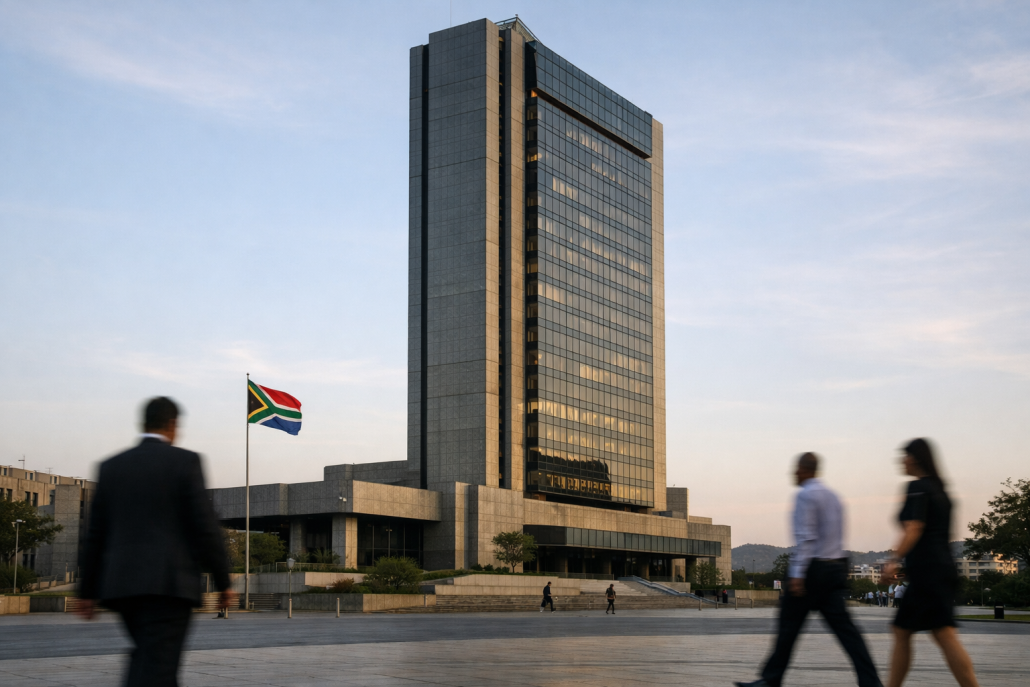
The finding — what the data shows — SARB November 2026 rate decision
The South African Reserve Bank’s Monetary Policy Committee held its sixth and final meeting of 2026 on 19 November 2026, with Governor Lesetja Kganyago scheduled to announce the outcome at 15:00 SAST. The meeting was confirmed on the SARB’s official website and MPC webcasts calendar. Here are the key numbers heading into the decision: These figures put the SARB November 2026 rate decision into clearer perspective.
- Repo rate going in: 7.25% (prime 10.75%)
- Last move: unanimous 25 bp hike on 23 September 2026
- 2026 policy path so far: hike in May, hold in July, hike in September
- October CPI: 5.2% — highest since May 2024
- SARB point target: 3%
- Fuel prices: +42.9% year-on-year
- Rand: touched 17 per US dollar, weakest since April
- Treasury fuel-levy relief: R10 bn
- Consensus expectation: hold at 7.25%
- Minority view (incl. Nedbank economic unit, Bank of America): residual risk of a 25 bp hike to 7.50%
Taken together, the backdrop was unusually split: an inflation print running at nearly double the target alongside a currency under pressure, versus softer global oil, targeted fiscal relief and a Quarterly Projection Model from the SARB itself pointing to broadly stable rates through year-end. This context matters for anyone following the SARB November 2026 rate decision.
What it means
The headline tension is straightforward. CPI at 5.2% against a 3% point target would, on a textbook reading, argue for more tightening. That is why a minority of forecasters, including Nedbank’s economic unit and Bank of America, still saw a residual risk of a move to 7.50%. It is a central thread in the wider SARB November 2026 rate decision.
Yet most economists surveyed ahead of the meeting leaned the other way. They pointed to the recent easing in global oil prices, the R10 bn fuel-levy relief announced by Treasury, and the SARB’s own projection model suggesting rates could stay broadly stable into year-end. In that reading, much of the October CPI spike was being driven by a single, external factor — a 42.9% year-on-year surge in fuel prices linked to the ongoing Middle East energy shock — rather than broad-based domestic overheating. Such details shaped how the SARB November 2026 rate decision unfolded.
The currency added another layer. With the rand touching 17 per dollar, its weakest since April, any dovish surprise risked further pressure on imported inflation. This is the classic emerging-market trade-off: defend the currency and anchor expectations, or avoid tightening into an economy that has shown clear signs of weakness. This is one of the defining aspects of the SARB November 2026 rate decision.
The decision was widely seen as a close call, and the meeting was covered by multiple South African outlets, including Moneyweb and The National, both of which framed it as a cliffhanger going into the announcement.
How this fits into South Africa’s banking landscape
Rate decisions in Pretoria ripple quickly through the branch and ATM network that households actually use. The prime rate of 10.75% going into the meeting feeds directly into mortgage repayments, vehicle finance and credit-card pricing across the big commercial banks, which is why MPC days are followed well beyond the trading floor.
If you want to see the physical footprint behind those headlines — where the branches and cash machines of the major lenders are actually located across the country — the directory of banks in South Africa on gf6.com lists the locations recorded in our database. It is a useful companion to a macro story like this one, because monetary policy is ultimately transmitted through exactly these outlets.
Explore the full data behind this article: bank branches worldwide and ATMs worldwide in the gf6.com directory.
Methodology
This article is a rewrite of a publicly reported financial event. The macro data points — the 7.25% repo rate, 10.75% prime rate, October CPI of 5.2%, the 42.9% year-on-year fuel-price move, the rand at 17 per dollar, the R10 bn Treasury fuel-levy relief, and the economist consensus — are taken from the official South African Reserve Bank monetary policy statement page for November 2026 and from coverage by Moneyweb and The National.
The branch and ATM context comes from gf6.com’s own curated worldwide directory of about 445,000 financial locations (roughly 346,000 branches and 99,000 ATMs), built manually from public sources since 2020 and expanded over four years. Coverage varies by country and the database is a large but incomplete sample; it is not an official or government dataset, and no figures have been added, estimated or recalculated beyond what is explicitly reported in the sources cited above.
Frequently asked questions
When did the SARB MPC hold its final 2026 meeting?
The Monetary Policy Committee held its sixth and final meeting of 2026 on 19 November 2026, with Governor Lesetja Kganyago announcing the outcome at 15:00 SAST according to the SARB’s official website and MPC webcasts calendar.
What was the repo rate going into the meeting?
The repo rate stood at 7.25%, with prime at 10.75%, following a unanimous 25 basis point hike on 23 September 2026. That September move was the second increase of the year, after a hike in May and a hold in July.
Why was inflation so far above target?
October CPI printed at 5.2%, the highest reading since May 2024 and well above the SARB’s 3% point target. The main driver reported was a 42.9% year-on-year surge in fuel prices linked to the ongoing Middle East energy shock, rather than broad-based domestic price pressure.
What did economists expect from the November decision?
Most economists surveyed expected a hold at 7.25%, citing easing global oil prices, R10 bn in fuel-levy relief from Treasury, and the SARB’s own Quarterly Projection Model pointing to broadly stable rates through year-end. A minority, including Nedbank’s economic unit and Bank of America, flagged a residual risk of another 25 bp hike to 7.50%.
How did the rand factor in?
The rand had touched 17 per US dollar, its weakest level since April, which raised the risk of further imported inflation. That currency weakness was one reason some analysts kept a hike on the table despite softer oil.
How does this connect to the gf6.com directory?
The directory records bank branches and ATMs around the world, including South Africa. It does not publish rates or policy decisions, but it provides the physical context — where the lenders affected by SARB policy actually operate — behind a story like this one.
This article was produced with AI assistance from publicly available sources and is handled under our editorial standards and AI policy.

I have been online since 1995. For many years, I worked in the e-commerce sector, setting up several online shops, and have always been interested in data analysis. In 2007, I moved to the Seychelles to work from there or as a digital nomad. In recent years, I have increasingly specialised in the financial sector. I manage the Seychelles’ Commercial Register and am also very familiar with the offshore world. GF6.com is a project I have been working on for many years. I built and curated the 445,000-entry bank database myself over a period of six years, and for the past two years or so I have also been using AI to achieve better structures.
More from this author →