
At approximately 1:30 p.m. on Friday, 6 November 2026, a single communications equipment malfunction at one data centre simultaneously disabled ATMs, branch counters and internet banking at 128 shinkin banks across western Japan — every such lender west of the Tokai region, covering roughly 3,430 branches from Tokai through Kyushu. Understanding the Shinkin bank ATM outage in full requires looking at these details closely.
The Shinkin bank ATM outage is a textbook illustration of concentration risk in shared financial infrastructure. Drawing on gf6.com’s four-year curated directory of branches and ATMs, this article sets out exactly what the public reporting confirms, what it does not, and why the design of Japan’s cooperative banking backbone matters far beyond the five-and-a-half-hour window the failure lasted.
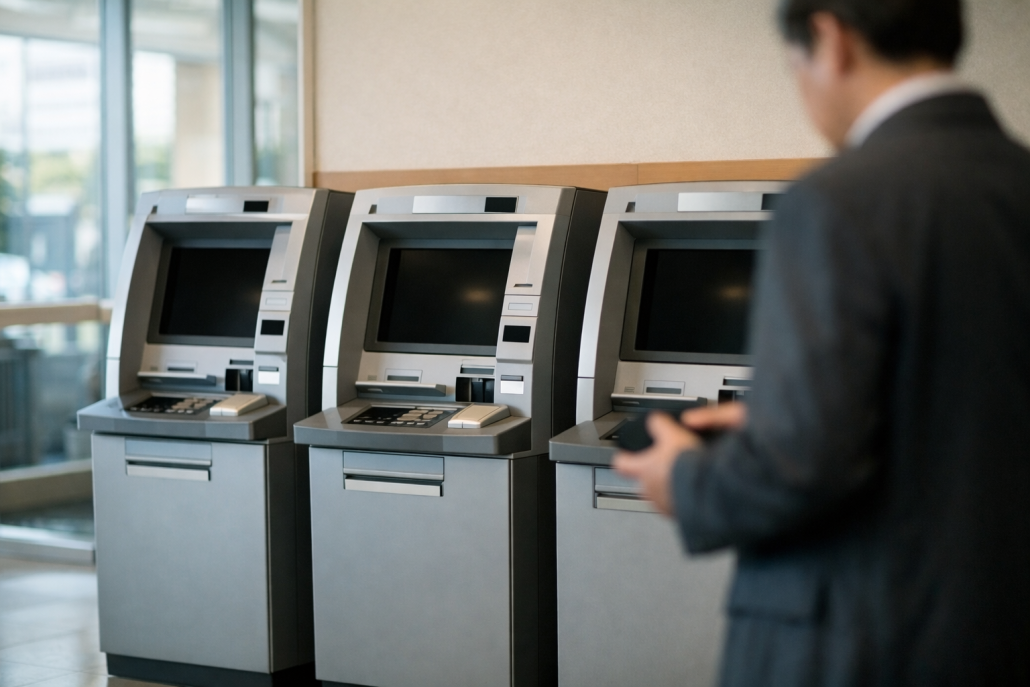
The finding — what the data shows — Shinkin bank ATM outage
A joint statement from Shinkin Central Bank and the Shinkin Kyodo Center confirmed the outage was caused by an equipment malfunction at the West Japan Centre of the Shinkin Kyodo Center, and explicitly ruled out a cyberattack. The eastern-Japan centre was unaffected and operated normally throughout. Full service was restored shortly after 7:00 p.m. the same day. These figures put the Shinkin bank ATM outage into clearer perspective.
The headline figures, exactly as reported:
| Metric | Value |
|---|---|
| Date and start time of outage | Friday, 6 November 2026, approximately 1:30 p.m. |
| Service restored | Shortly after 7:00 p.m. the same day |
| Cause (per joint statement) | Communications equipment malfunction at Shinkin Kyodo Center’s West Japan Centre |
| Cyberattack | Explicitly ruled out |
| Shinkin banks affected | 128 (every shinkin lender west of the Tokai region) |
| Branches affected | Roughly 3,430, from Tokai through Kyushu |
| Services disabled | ATMs, branch counter transactions, internet banking |
| Shinkin Joint System total membership | 236 shinkin banks (more than 90% of all such lenders in Japan) |
| Named institutions affected | Okazaki Shinkin Bank, Osaka City Shinkin Bank, Hiroshima Shinkin Bank |
The event was reported by multiple outlets, including Nippon.com, and independently corroborated by Outlook India and Glitchwire.
What it means
The most striking number is not 128 — it is the geographic cleanness of the split. One communications failure at one site took down exactly the western half of a system that underpins more than 90% of Japan’s shinkin lenders, while the eastern half continued to run normally. That is what shared core-banking infrastructure looks like when a regional node fails: the blast radius matches the architecture, not the individual bank. This context matters for anyone following the Shinkin bank ATM outage.
Shinkin banks are cooperative lenders whose customer base skews heavily towards small businesses and sole traders. A Friday afternoon is a common settlement window for such customers — payroll runs, supplier payments, cash top-ups for the weekend. The reporting notes that small businesses and sole traders relying on shinkin banks for daily payments faced acute disruption during the five-and-a-half-hour window. It is a central thread in the wider Shinkin bank ATM outage.
It is worth separating fact from interpretation. The fact is that ATMs, counter services and internet banking all failed together across 128 institutions because they share a common system. The likely implication — that participation in a shared joint system concentrates operational risk even as it lowers per-bank IT costs — is a widely held reading of events of this kind, but it is an interpretation, not something the operators have conceded. Such details shaped how the Shinkin bank ATM outage unfolded.
It is also worth noting what the public statements do not say. There is no published figure, in the sources available, for how many individual transactions failed, how many ATM withdrawal attempts were rejected, or what the aggregate value of delayed payments was. Those numbers may emerge later; they are not in the current record.
Explore the full data behind this article: bank branches worldwide and ATMs worldwide in the gf6.com directory.
Methodology
All event-specific figures in this article — the 128 affected lenders, the roughly 3,430 branches, the 1:30 p.m. start, the post-7:00 p.m. restoration, the 236-bank total membership of the Shinkin Joint System, and the named institutions — are taken verbatim from the joint statement by Shinkin Central Bank, the Shinkin Kyodo Center and the National Association of Shinkin Banks, as reported by Nippon.com and corroborated by Outlook India and Glitchwire.
For context on the network of institutions involved, you can browse the gf6.com directory entry for banks in Western Japan (Tokyo-based Shinkin Central Bank). The gf6.com directory is a curated original dataset of roughly 445,000 bank branch and ATM locations worldwide, built manually from public sources since 2020 and expanded over four years. It is a large but incomplete sample; coverage varies by country, and the directory does not claim to be an official or exhaustive register.
Frequently asked questions
How long did the Shinkin bank ATM outage last?
The failure began at approximately 1:30 p.m. on 6 November 2026 and full service was restored shortly after 7:00 p.m. the same day — a window of roughly five and a half hours.
How many banks and branches were affected?
128 shinkin banks — every shinkin lender west of the Tokai region — covering roughly 3,430 branches from Tokai through Kyushu. ATMs, branch counter transactions and internet banking were all disabled.
Was this a cyberattack?
No. The joint statement from Shinkin Central Bank and the Shinkin Kyodo Center explicitly ruled out a cyberattack, attributing the outage to a communications equipment malfunction at the Shinkin Kyodo Center’s West Japan Centre.
Why did one failure hit so many separate banks?
The 128 affected lenders all rely on the Shinkin Joint System, a shared core-banking platform that underpins 236 shinkin banks in total — more than 90% of all such lenders in Japan. The west-Japan centre failed; the east-Japan centre was unaffected and continued to operate normally.
Which specific shinkin banks were named?
Named institutions affected in the reporting included Okazaki Shinkin Bank, Osaka City Shinkin Bank and Hiroshima Shinkin Bank. The full list spans all 128 shinkin lenders west of the Tokai region.
Who was most affected by the outage?
Shinkin banks cater heavily to small businesses and sole traders. Those relying on shinkin accounts for daily payments faced acute disruption during the Friday afternoon window, before services came back online in the evening.
This article was produced with AI assistance from publicly available sources and is handled under our editorial standards and AI policy.

I have been online since 1995. For many years, I worked in the e-commerce sector, setting up several online shops, and have always been interested in data analysis. In 2007, I moved to the Seychelles to work from there or as a digital nomad. In recent years, I have increasingly specialised in the financial sector. I manage the Seychelles’ Commercial Register and am also very familiar with the offshore world. GF6.com is a project I have been working on for many years. I built and curated the 445,000-entry bank database myself over a period of six years, and for the past two years or so I have also been using AI to achieve better structures.
More from this author →
