
The Swiss National Bank spent CHF 1.4 billion buying foreign currency between April and June 2026 to hold back a rising franc — a figure disclosed on 30 September 2026 that was less than half the CHF 3.9 billion it deployed in the first quarter. The drop matters because it hints that safe-haven pressure tied to the Iran conflict eased just enough for Switzerland’s zero-rate central bank to step back from the market. Understanding the SNB FX intervention in full requires looking at these details closely.
This piece summarises that SNB FX intervention disclosure using the SNB’s own scheduled quarterly release and cross-checks from independent financial calendars and market commentary. The context around it — a 0% policy rate, a lifted inflation forecast, and a franc that weakened after July — is drawn strictly from the same public event, without speculation. The article is published via gf6.com, a worldwide directory of banks and ATMs.
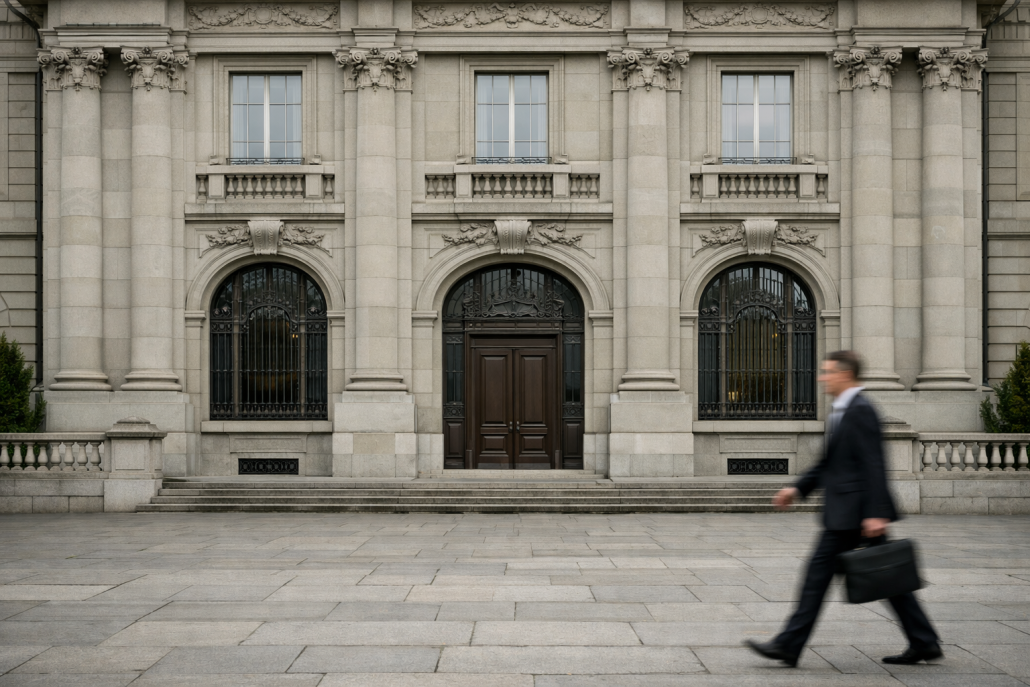
The finding — what the SNB disclosed on 30 September 2026 — SNB FX intervention
According to the release, the SNB purchased CHF 1.4 billion in foreign currency during Q2 2026, a sharp reduction from Q1. The numbers below are reproduced from the disclosure and corroborating calendar entries. These figures put the SNB FX intervention into clearer perspective.
| Item | Value |
|---|---|
| Q2 2026 FX purchases by SNB | CHF 1.4 billion |
| Q1 2026 FX purchases by SNB | CHF 3.9 billion |
| SNB policy rate (24 September 2026 assessment) | 0% |
| Franc move since July | Weakened roughly 2.4% |
| Disclosure date | 30 September 2026 |
| Trigger for heightened readiness statement | Iran conflict (began in March) |
| Inflation forecast revision | Lifted for every year through 2028 |
The event was reported by multiple outlets and appears in the official Swiss financial calendar. See the original write-up at Meyka, with corroboration from cash.ch and Admiral Markets.
What it means
The headline number is smaller than in Q1, but the disclosure itself is the story. Switzerland remains the only major G10 economy with zero interest rates as of the September meeting, which leaves FX intervention as the SNB’s main residual lever. When a rate cut is not on the table, buying euros and dollars to sell francs is what a central bank has left. This context matters for anyone following the SNB FX intervention.
The Iran conflict that began in March had already forced the SNB into an unusual mid-quarter statement of heightened readiness to intervene — a break from its normal habit of speaking only through scheduled channels. By the September assessment the language had reverted to standard, and the franc had weakened roughly 2.4% since July, easing the pressure that had built up earlier in the year. It is a central thread in the wider SNB FX intervention.
At the same 24 September assessment the SNB held its policy rate at 0% and lifted its inflation forecast for every year through 2028. That combination — a higher inflation path but no rate move, plus a lower quarterly intervention figure — is generally read as a central bank that is comfortable stepping back for now, though it does not commit the SNB to any particular path from here. Such details shaped how the SNB FX intervention unfolded.
For traders in EUR/CHF and USD/CHF, the quarterly disclosure is one of the few hard data points on how active the SNB actually is. Because Switzerland publishes the figures with a lag, the market often reacts more to the disclosure than to the intervention itself. This is one of the defining aspects of the SNB FX intervention.
Explore the full data behind this article: bank branches worldwide and ATMs worldwide in the gf6.com directory.
Methodology
This article is a rewrite of a publicly reported event. The primary source is the SNB’s scheduled Q2 2026 FX intervention disclosure published on 30 September 2026, first covered by Meyka and corroborated by the Swiss financial week-ahead calendar on cash.ch and market commentary on Admiral Markets. All figures, dates and quotes are taken directly from those sources; nothing has been estimated or inferred. For location context you can browse banks in Zürich / Switzerland in the gf6.com directory, a curated worldwide list of bank branches and ATMs. The directory is a large but incomplete sample and is not an official source.
Frequently asked questions
How much did the SNB spend on FX intervention in Q2 2026?
The SNB disclosed CHF 1.4 billion in foreign currency purchases for April–June 2026. That was down sharply from CHF 3.9 billion in Q1 2026.
Why did the SNB intervene at all?
To counter safe-haven demand that was pushing the franc higher, driven in part by the Iran conflict that began in March. A stronger franc weighs on Swiss exporters and pulls inflation lower, which the SNB tries to prevent.
Why not just cut interest rates further?
The SNB’s policy rate is already at 0% as of the 24 September 2026 assessment, and Switzerland remains the only major G10 economy with zero rates. With conventional rate policy effectively exhausted at that level, FX intervention becomes the main residual tool.
Did the SNB signal more intervention ahead?
At the September assessment it reverted to standard intervention language, after an unusual mid-quarter statement earlier in the year flagging heightened readiness. It also lifted its inflation forecast for every year through 2028 while holding the rate at 0%.
How was the franc trading around the disclosure?
The franc had weakened roughly 2.4% since July, which reduced the immediate pressure on the SNB heading into the disclosure.
Where can I read the original reporting?
The event was covered by Meyka and appears in the Swiss financial week-ahead calendar on cash.ch, with additional context from Admiral Markets. Links to all three are included above.
This article was produced with AI assistance from publicly available sources and is handled under our editorial standards and AI policy.

I have been online since 1995. For many years, I worked in the e-commerce sector, setting up several online shops, and have always been interested in data analysis. In 2007, I moved to the Seychelles to work from there or as a digital nomad. In recent years, I have increasingly specialised in the financial sector. I manage the Seychelles’ Commercial Register and am also very familiar with the offshore world. GF6.com is a project I have been working on for many years. I built and curated the 445,000-entry bank database myself over a period of six years, and for the past two years or so I have also been using AI to achieve better structures.
More from this author →
