
Uganda’s central bank kept its benchmark rate at 12% on Monday 9 November 2026 — the highest setting since 2017 — choosing to let an emergency 225-basis-point hike delivered just weeks earlier work its way through the economy. The hold came alongside a higher inflation forecast and a downgraded growth outlook, a combination that frames the next few months as a careful wait-and-see exercise rather than the end of tightening. Understanding the Bank of Uganda central bank rate in full requires looking at these details closely.
This article walks through what the Monetary Policy Committee actually decided, how the numbers fit together, and why the Bank of Uganda central bank rate decision matters beyond Kampala. The event itself is public and widely reported; the directory context is drawn from gf6.com’s own four-year curated database of bank and ATM locations worldwide, via gf6.com.
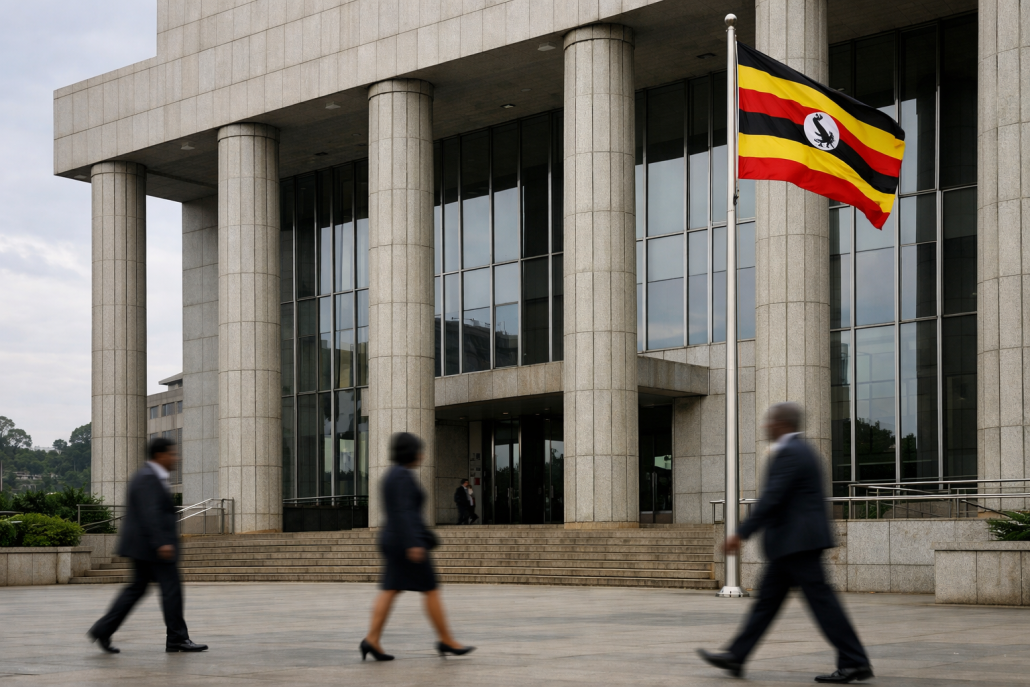
The decision — what the Bank of Uganda did — Bank of Uganda central bank rate
At its 9 November 2026 meeting, the Monetary Policy Committee left the Central Bank Rate unchanged and reaffirmed the tighter policy stance it had put in place in October. The headline numbers were accompanied by revised macro projections and a structural change to how the policy corridor is set. These figures put the Bank of Uganda central bank rate into clearer perspective.
- Central Bank Rate: held at 12% — the highest level since 2017
- Previous move: emergency 225-basis-point hike on 14 October 2026, from 9.75% to 12%
- Cash reserve requirement: raised in October from 11% to 13.5% for commercial banks
- Headline inflation forecast (next 12 months): revised higher to 7.5–8.0%
- October headline CPI: 5.8%, a three-year high
- FY2026/27 GDP growth projection: cut to 5.5–6.0% from 6.0–6.5%
- CBR operating band: widened from two to three percentage points on either side
- Rediscount rate: raised to 16%
- Bank rate: raised to 17%
The October hike was explicitly framed as a defence of the shilling, which had slid sharply before the emergency meeting. The November decision to pause — rather than add more — signals that policymakers consider the current setting restrictive enough for now, provided incoming data cooperates. This context matters for anyone following the Bank of Uganda central bank rate.
The event was reported by multiple outlets, including CNBC Africa, ChimpReports and CEO East Africa.
What it means
The combination is unusual: inflation is being revised up, growth is being revised down, and the policy rate is being held. That ordering tells you the committee believes the October jump already did much of the heavy lifting and now needs time to transmit through credit, deposits and the exchange rate. It is a central thread in the wider Bank of Uganda central bank rate.
Governor Michael Atingi-Ego summarised the stance plainly: “The Monetary Policy Committee judged that the current financial conditions are tight enough, notwithstanding the continuing uncertainty.” The language leaves the door open for further moves in either direction without pre-committing. Such details shaped how the Bank of Uganda central bank rate unfolded.
The widening of the operating band from two to three percentage points on either side of the CBR, together with the 16% rediscount rate and 17% bank rate, is a technical but meaningful tightening of liquidity conditions for banks. In practice it makes short-term funding from the central bank more expensive and pushes market rates higher at the margins, reinforcing the headline hold. This is one of the defining aspects of the Bank of Uganda central bank rate.
For other small, open frontier economies watching Kampala, the sequence — emergency hike to defend the currency, then a pause with a hawkish tilt and a higher inflation forecast — is a recognisable template. Whether it works depends on how quickly the shilling stabilises and whether the 5.8% October CPI print proves to be near the peak.
How this fits with Uganda’s banking network
Monetary policy decisions like this one eventually reach households and small businesses through the commercial bank branches and ATMs where people actually hold deposits and borrow. A higher cash reserve requirement means banks must park more of their deposits at the central bank, which tends to tighten the credit that filters out to branch customers.
If you want to see where regulated deposit-taking institutions physically operate across the country, the directory of banks in Uganda on gf6.com lists branches and ATMs recorded in our database. Coverage is a sample, not a census, but it gives a practical sense of the footprint behind the policy headlines.
Why this matters beyond Uganda
Small Sub-Saharan African central banks face a particular trade-off when their currency comes under pressure: hike hard enough to defend the exchange rate, but not so hard that domestic growth collapses. Uganda’s October move — a 225-basis-point jump plus a reserve requirement increase — sits at the aggressive end of that spectrum, and the November hold is the natural pause to assess damage and transmission.
The downgraded FY2026/27 GDP growth projection of 5.5–6.0%, versus the earlier 6.0–6.5%, is the cost side of that trade. It is still a respectable growth figure by global standards, but the revision acknowledges that tighter financial conditions will bite. Investors and businesses in similar markets — where currency stability, imported inflation and credit availability are all intertwined — will be watching how quickly Uganda can move from defence back to a more neutral stance.
Methodology
This is a news rewrite based on public reporting of the Bank of Uganda’s Monetary Policy Committee meeting of 9 November 2026. All rate levels, forecast ranges and dates are taken from the statements reported by CNBC Africa, ChimpReports and CEO East Africa. The branch and ATM context comes from gf6.com’s own curated directory of financial locations worldwide, which began in 2020, reached a first largely complete version in 2022, and has since been expanded through public-source research and manual verification. It is a large but incomplete sample and is not an official or government dataset. For the country listing see banks in Uganda.
Frequently asked questions
What did the Bank of Uganda decide on 9 November 2026?
The Monetary Policy Committee held the Central Bank Rate unchanged at 12%. It kept in place the October tightening measures, raised its inflation forecast and lowered its growth projection.
Why was 12% described as significant?
Because it is the highest level for the CBR since 2017. The 12% rate was reached through an emergency 225-basis-point hike on 14 October 2026, from 9.75%.
What happened to bank reserve requirements?
In October the cash reserve requirement for commercial banks was raised from 11% to 13.5%. That change was not reversed at the November meeting.
What are the new inflation and growth forecasts?
Headline inflation over the next 12 months is now projected at 7.5–8.0%, up from earlier expectations. FY2026/27 GDP growth was revised down to 5.5–6.0% from 6.0–6.5%. October headline CPI came in at 5.8%, a three-year high.
What changed in the policy corridor?
The CBR operating band was widened from two to three percentage points on either side of the benchmark. The rediscount rate was lifted to 16% and the bank rate to 17%.
Does gf6.com report Bank of Uganda policy officially?
No. gf6.com is a worldwide directory of bank branches and ATMs. This article summarises public reporting of the central bank’s decision for context; the central bank’s own statements are the official source.
This article was produced with AI assistance from publicly available sources and is handled under our editorial standards and AI policy.

I have been online since 1995. For many years, I worked in the e-commerce sector, setting up several online shops, and have always been interested in data analysis. In 2007, I moved to the Seychelles to work from there or as a digital nomad. In recent years, I have increasingly specialised in the financial sector. I manage the Seychelles’ Commercial Register and am also very familiar with the offshore world. GF6.com is a project I have been working on for many years. I built and curated the 445,000-entry bank database myself over a period of six years, and for the past two years or so I have also been using AI to achieve better structures.
More from this author →