
The Country With the Most ATMs Isn’t the One You’d Expect
The country with the most ATMs in our directory is not the United States. It is Russia, with 33,209 cash machines recorded — almost 4,000 more than the United States, and ahead of Germany too. For a country often discussed in terms of sanctions and a shrinking banking sector, that is a striking position at the top of the global ATM table.
The figure comes from gf6.com’s own bank and ATM directory, a four-year curated database compiled from OpenStreetMap, official bank registries and manual research. Below you will see the full top ten for both ATMs and bank branches, what the contrast between the two rankings suggests, and exactly how the numbers were gathered.
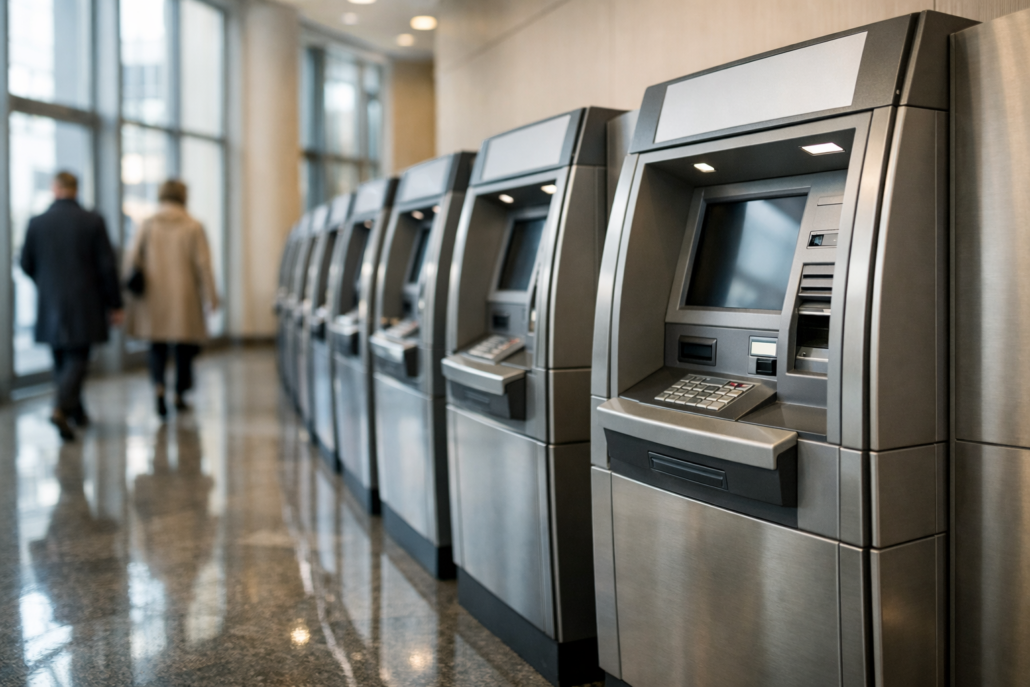
The finding — what the data shows — Country with the most ATMs
Across the roughly 745,000 financial locations in our directory, Russia tops the ATM ranking while the United States tops the bank branch ranking by a wide margin. Here is the count of ATMs per country in our database:
Most ATMs by country:
- Russia 33,209
- Germany 30,624
- United States 29,222
- France 23,745
- India 14,785
- United Kingdom 14,386
- Italy 13,609
- Poland 12,215
- Japan 11,913
- Spain 10,719
And here is the same exercise for staffed bank branches:
Most bank branches by country:
- United States 49,083
- Germany 23,583
- Russia 21,572
- France 18,681
- India 16,584
- Spain 13,612
- Italy 12,642
- Japan 12,541
- Iran 12,100
- Brazil 11,291
What it means
The most obvious story is the swap at the top. Russia leads on ATMs (33,209) but sits third on branches (21,572). The United States is the opposite: 49,083 branches — more than double Germany’s — but only 29,222 ATMs in our dataset, putting it third on cash machines.
That contrast is consistent with how the two countries handle retail banking. Russia has historically leaned on standalone ATM and payment-terminal networks operated by large banks such as Sberbank and VTB, often clustered in metro stations, supermarkets and street kiosks. The US, by contrast, is built around a dense network of community banks, credit unions and commercial branches — a structural feature that very few other countries share at that scale.
Germany is the only country to appear in the top three of both tables (30,624 ATMs, 23,583 branches), which fits a banking system split across savings banks (Sparkassen), cooperative banks (Volksbanken) and private banks, each maintaining their own infrastructure. India, Japan, Italy, Spain and France also appear in both top tens — large economies with broad physical coverage. Notable single-list appearances include the United Kingdom and Poland (ATMs only) and Iran and Brazil (branches only).
A careful word on causation: these counts describe what is in our directory, not the absolute number of machines or branches in operation in each country. A high ATM count likely reflects both real machine density and how thoroughly that country has been mapped in our sources. Treat the rankings as a strong signal, not a census.
Explore the full data behind this article: bank branches worldwide and ATMs worldwide in the gf6.com directory.
Methodology
These figures come from gf6.com‘s own bank and ATM directory – a dataset begun in 2020, first largely complete in 2022, and expanded over four years through manual collection and enrichment from public sources including OpenStreetMap and official bank registries. The numbers reflect locations recorded in our database, a large but incomplete sample of the world’s financial infrastructure; coverage varies by country. Figures are free to cite with a link to gf6.com.
We do not claim these counts are official or government-verified. They are what gf6.com has been able to record, deduplicate and geocode after four years of work. Where a single physical site hosts multiple machines, each ATM is counted separately if it appears as a distinct record in the source data.
Frequently asked questions
Which country has the most ATMs in the world?
In the gf6.com directory, Russia leads with 33,209 ATMs, followed by Germany with 30,624 and the United States with 29,222. These are counts from our curated database, not an official global census.
Why does the United States have so many more bank branches than ATMs?
The US has 49,083 branches in our data versus 29,222 ATMs — a structural feature of a banking system with thousands of community banks and credit unions, each running its own staffed locations. Many US ATMs are also operated by independent, non-bank networks that are harder to map comprehensively.
Is Russia really ahead of Germany and the US for ATMs?
In our dataset, yes — Russia is recorded with 33,209 machines, ahead of Germany (30,624) and the United States (29,222). This reflects both real ATM density in Russian cities and the way Russian banks deploy large, branded ATM fleets.
Why isn’t China in either top ten?
China is not present in our top ten for ATMs or branches. That likely reflects limited coverage of Chinese banking infrastructure in the public sources we draw on, rather than a small banking sector. We are transparent that the dataset is incomplete and country coverage is uneven.
Can I cite these numbers?
Yes. The figures are free to cite as long as you link to gf6.com as the source. We recommend describing them as “locations recorded in gf6.com’s directory” rather than as official totals.
How often are the figures updated?
The directory has been built and refined continuously since 2020, with manual research and re-imports from public registries throughout. Counts shift as new sources are added and duplicates are cleaned, so a future snapshot may differ slightly from the numbers shown here.

