
Türkiye’s central bank kept its benchmark overnight lending rate at 37% on 1 June 2026 — the third consecutive meeting without a change, and the clearest signal yet that this year’s easing cycle has been paused. The decision was in line with market expectations. Understanding the CBRT policy rate June 2026 in full requires looking at these details closely.
This piece is a plain-language rewrite of the CBRT policy rate June 2026 decision, based on the original reporting linked below. It is published in the news section of gf6.com, a worldwide bank and ATM directory, to give readers using our country pages a quick, sober summary of what changed for the banking backdrop in Türkiye.
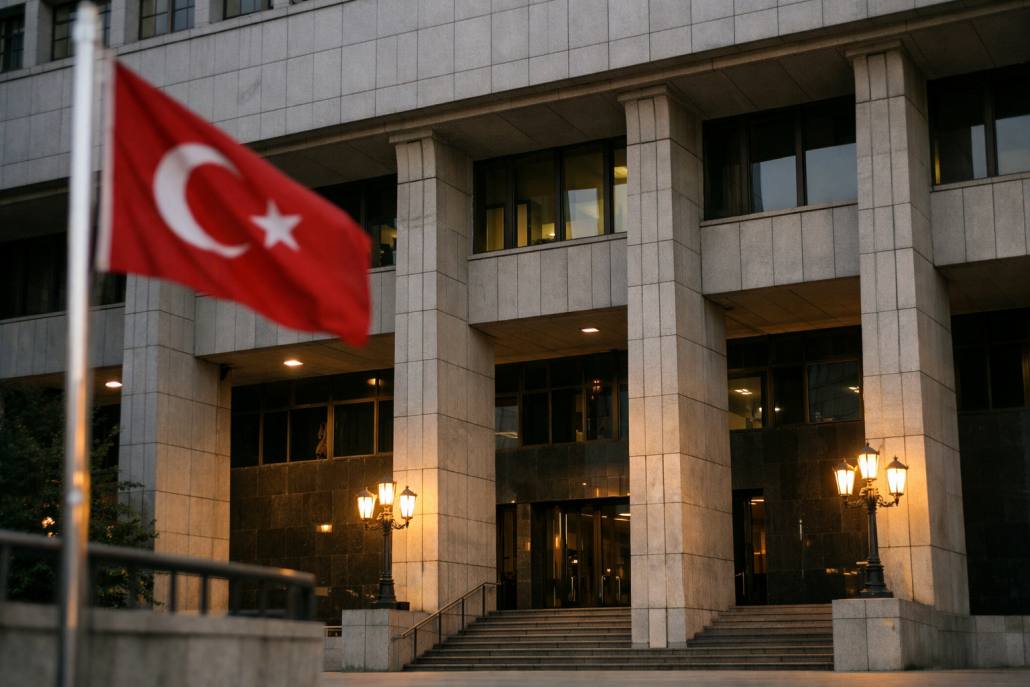
The finding — what the CBRT actually decided — CBRT policy rate June 2026
The Central Bank of the Republic of Turkey (CBRT) announced on 1 June 2026 that it would leave its policy rate unchanged. The decision, in its own words, was driven by external price pressures that have shifted the near-term inflation trajectory. These figures put the CBRT policy rate June 2026 into clearer perspective.
The core facts of the June 2026 statement are:
- The Central Bank of the Republic of Turkey maintained its benchmark overnight lending rate at 37%.
- This was the third straight decision to hold at that level.
- The move was aligned with market expectations.
- The bank noted that recent increases in energy prices due to the war in the Middle East had lifted the underlying trend in inflation.
- The bank stated that this ends this year’s rate-cutting cycle.
- The bank reiterated that rates will remain restrictive until price stability is achieved.
What it means
The most important line in the statement is not the 37% level itself — it is the explicit acknowledgement that the easing cycle is over for now. Earlier in the year, the CBRT had been gradually reducing rates; June’s decision closes that chapter and re-anchors policy in a defensive posture. This context matters for anyone following the CBRT policy rate June 2026.
The reason the bank gives is external rather than domestic. Higher energy prices, which the statement links to the war in the Middle East, are described as lifting the underlying trend in inflation. In other words, an imported shock — not a fresh burst of domestic demand — is what has changed the calculation. It is a central thread in the wider CBRT policy rate June 2026.
The commitment to keep policy restrictive “until price stability is achieved” is language the CBRT has used before. It is generally read by markets as a signal that further cuts are off the table until the inflation trend turns clearly downwards again, though the statement itself does not commit to any timeline. Such details shaped how the CBRT policy rate June 2026 unfolded.
For anyone tracking banks in Türkiye, the practical consequence is that lending and deposit rates offered by commercial banks are likely to stay in the current elevated range for longer than the earlier easing path implied. The bank has not indicated when conditions might change.
How this fits the wider policy picture
Emerging-market central banks that had begun cutting rates in 2026 have faced a common problem: an external energy shock that risks re-igniting inflation just as domestic price growth was cooling. The CBRT’s June decision is a textbook example of that pivot from easing to hold. This is one of the defining aspects of the CBRT policy rate June 2026.
Importantly, the bank did not hike. Holding at 37% signals that the current stance is judged tight enough to absorb the energy shock, provided it is not extended by another cut. That is a middle path between the earlier cutting trajectory and an outright tightening response, and it keeps optionality open in either direction at future meetings.
Explore the full data behind this article: bank branches worldwide and ATMs worldwide in the gf6.com directory.
Methodology
This article is a rewrite in our own words of a publicly reported monetary-policy decision. All specific facts — the 37% level, the third consecutive hold, the reference to Middle East energy prices, and the end of the rate-cutting cycle — are taken directly from the original reporting and the CBRT’s own statement as summarised there. No additional figures, forecasts or quotes have been added.
Original source: Trading Economics — Turkey Interest Rate. gf6.com is a worldwide directory of bank branches and ATMs; we publish short news summaries alongside our country pages to give context to readers looking up local banking infrastructure. This is not investment advice.
Frequently asked questions
What did the CBRT decide on 1 June 2026?
The Central Bank of the Republic of Turkey kept its benchmark overnight lending rate unchanged at 37%. It was the third consecutive meeting at which the bank held rates at that level.
Why didn't the CBRT keep cutting rates?
The bank said recent increases in energy prices, linked to the war in the Middle East, had lifted the underlying trend in inflation. It explicitly described the decision as ending this year’s rate-cutting cycle.
Was the decision a surprise?
No. According to the reporting, the hold at 37% was aligned with market expectations, so investors and analysts were broadly positioned for it.
Does this mean rates will rise next?
The statement does not say that. It says only that rates will remain restrictive until price stability is achieved. That language is consistent with a prolonged hold rather than an automatic hike.
How does this affect customers of Turkish banks?
The policy rate is one input into commercial lending and deposit pricing, but individual banks set their own rates. In general, a hold at a high policy rate tends to keep borrowing costs elevated for longer than a continued cutting cycle would have.
Where can I read the original report?
The source used for this rewrite is the Trading Economics page on Turkey’s interest rate, linked in the methodology section above.

I have been online since 1995. For many years, I worked in the e-commerce sector, setting up several online shops, and have always been interested in data analysis. In 2007, I moved to the Seychelles to work from there or as a digital nomad. In recent years, I have increasingly specialised in the financial sector. I manage the Seychelles’ Commercial Register and am also very familiar with the offshore world. GF6.com is a project I have been working on for many years. I built and curated the 445,000-entry bank database myself over a period of six years, and for the past two years or so I have also been using AI to achieve better structures.
More from this author →
